


Disrupting rent collection in Denmark
A step toward transforming BoligPortal from an advertising marketplace into an administration platform is to manage and control one of the most important aspects of a landlord’s business: collecting rent from tenants.
Company
BoligPortal
My role
Product manager and Designer
Time period
2022
More than a marketplace
For years BoligPortal helped landlords with the exciting parts of renting out a property. Advertising a listing. Signing the contract. Doing the move-in inspection. All the moments where something actually happens.
But that's a handful of days a year.
The rest of the time the landlord was doing admin, and we weren't there for any of it. So we started asking what those other days actually looked like. Collecting rent wasn't the headache we expected it to be. Most landlords have a system that works well enough, even if that system is a spreadsheet and a bank statement.
The headaches were all the things attached to it.
Every year you have to regulate the rent against the Danish net price index. Every year you have to do utility accounting: how much did the tenant pay for heating, how much did they actually use, who owes who. And when a payment doesn't arrive, you have to figure out why, which usually means waiting for a letter or calling someone.
That's the real work. Rent collection is just the thing all of it hangs off. So we set the goal early: collecting rent on BoligPortal should be free, easy, and good enough that using anything else feels silly. A no-brainer for our segment.
Strategically, this move was crucial. Once we became the solution landlords used to collect rent, we could build on that foundation and automate all the annoying, time-consuming tasks. It also gave us a way to monetize that part of the platform.
From the first call to product launch
I led the project from the first customer call to launch.
I interviewed our first customers to identify their real pain points, created initial sketches of potential solutions, conducted user tests, engaged with payment partners, defined the product and design vision, and collaborated with developers to build and launch the product.
In discovery I spent a lot of time talking to as many customers as I could. Those conversations ranged from straight interviews to putting an early prototype in front of someone and watching what they made of it.
The process took about a year and included five to six releases. We started with the basic system and ultimately partnered with MobilePay and Mastercard (PBS) to make it as easy as possible for companies to move from manual to automated payments. Nothing like it existed on the market.
Because BoligPortal owns the solution, I can’t share specific figures. However, many satisfied customers have used it for two to three years, and we process several million kroner in transactions each month.
First movers in a market
If I had to highlight one part of what we built, it would be the MobilePay integration.
Traditionally, PBS was the only method for automating rent payments because it was the only provider able to make direct bank-to-bank transfers for a fixed fee. All other solutions used a pricing model based on the transfer amount, which meant substantial fees on a monthly rent of, say, 10.500 kr.
By using MobilePay’s subscription API, we created a solution that allowed landlords to get started almost instantly. It also provided tenants with a much more modern and transparent user experience.
Watch a short demo I recording for one of our webinar promotions down below:
Their API also opened up things the other providers simply couldn’t do.
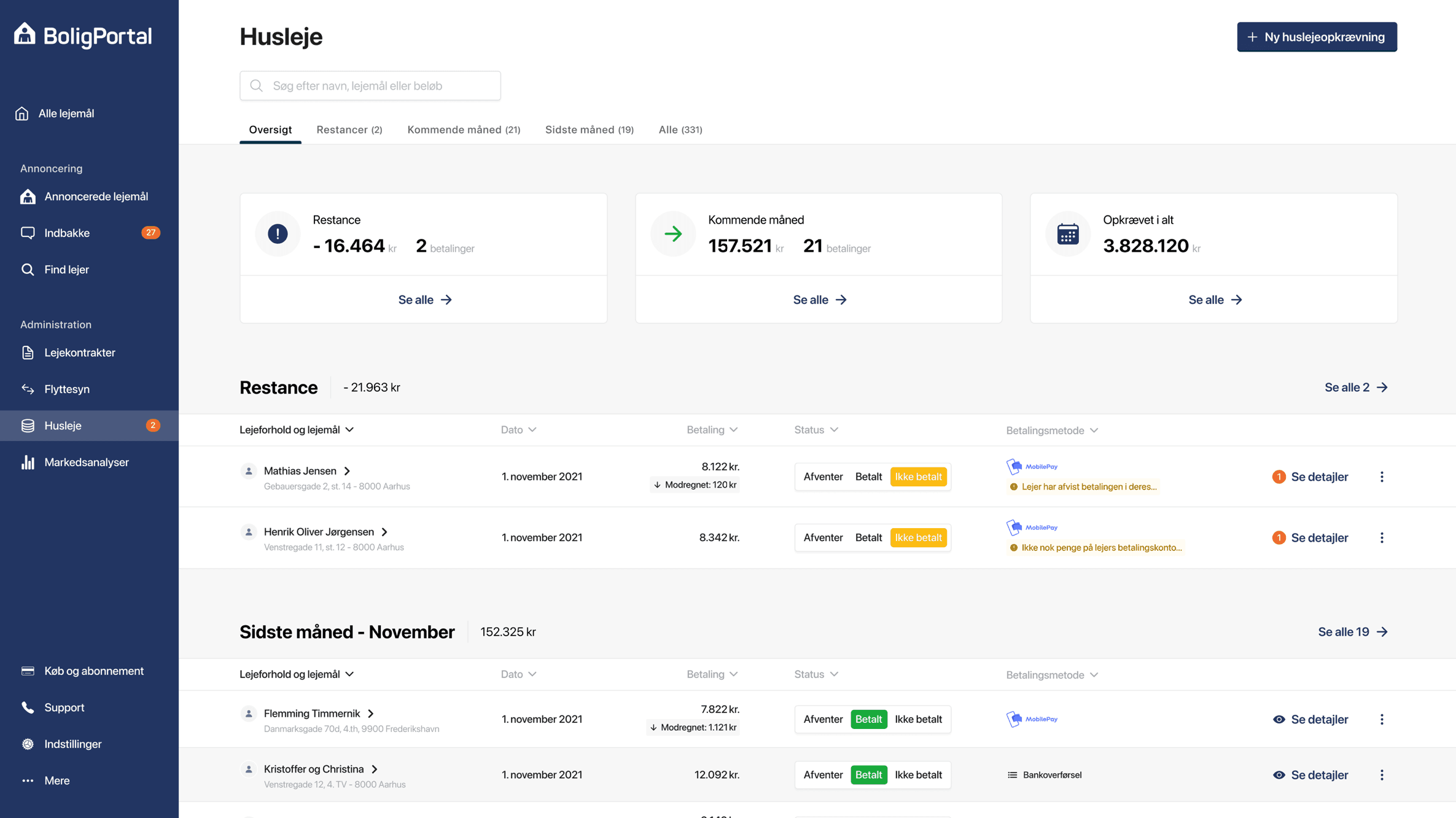
One example was how we used API callback codes for failed payments and presented the information as clearly and proactively as possible. Failed payments had always been a black hole for landlords. They had no way of knowing whether a payment had failed because the tenant had insufficient funds, there was a connection issue, or something else had gone wrong.
With this new approach, we could instantly and naturally inform landlords of the reason for a failed payment and suggest the next steps to resolve it.


What happened after the product launch
Beyond the adoption itself, the months after launch turned out to be the most rewarding part of the whole project.
One reason was getting to promote it. We hosted several live webinars where curious users could sign up to see the product presented and ask questions after the demo. It was a direct line to the people actually using it.
However, nothing beats meeting users in person. I was fortunate that the product was included on the agenda for our semiannual network meetings in Denmark’s four largest cities, where I was the main speaker. I gave a 20-minute presentation about the product and shared insights into upcoming ideas and features. Afterwards, everyone could try a demo and ask me questions.


We were also invited by MobilePay to speak at their developer conference. There we showed how we had used their product in a way they hadn’t seen before, and how it was helping landlords automate more of their day-to-day business.
Read more about that presentation here:
